In the center of the square in the Kombinati neighborhood in Tirana, stands a concrete pedestal where a statue of Josef Stalin, the leader of the former Soviet Union, once stood. Now torn down and removed, the statue has left its former base empty and somewhat exposed. A red communist star still stands next to it, perhaps intentionally left behind as a symbol of victory, as if to demonstrate what has been overthrown.
The park surrounding the former statue is overrun with stray dogs that coexist peacefully with humans, but not with the dogs of the neighbouring territories. Behind where Stalin’s statue once stood is a building resembling a Latin American manor, with a majestic arched entrance gate framed by two identical columns. The rest of the structure features rows of symmetrical windows arranged with strict precision.
Part of the building features a new white facade; it houses Municipal Unit No. 6, which serves as the administrative office for the Kombinati neighborhood of the Municipality of Tirana.
The rest of the building, adjacent to the municipal office, is clad in a weathered brown facade. In front of it stand several pieces of scaffolding, the kind usually put up when construction work is underway, but there are no workers in sight. The scaffolding joints are rusty, and the green netting is torn. No one is in sight.
On the other side of where Stalin once stood, several cafés are located in front of the city bus stop, as well as the taxi stand along the main road. At one of the tables in these cafés, two men are chatting; one of them is Murat Xhelo. Asked if there are still homes in the area damaged by the 2019 earthquake, whose residents have not yet returned, Xhelo gestures first at himself, then toward the part of the Kombinat building covered with abandoned scaffolding.

The building where Murat Xhelo and his family lived until the night of the earthquake / Photo: Atdhe Mulla / K2.0
On the night of 26 November 2019, a 6.4-magnitude earthquake shook Albania. With its epicenter in the northwest of the country, the earthquake caused severe damage, particularly in Thumanë, Durrës, Lezhë and Tirana. Fifty-one people were killed, thousands were injured and there have been around 1 billion euros in material damages recorded. Houses, high-rise apartment buildings and businesses across the country were damaged to varying degrees — from complete collapse to structural cracks that made further inhabitation impossible.
Many buildings in Albania had been constructed in violation of safety standards, with illegal building levels, poor-quality materials or without proper oversight from relevant institutions. These longstanding deficiencies directly contributed to the scale of the destruction caused by the earthquake. Following the disaster, the prosecutor’s office launched investigations into the builders, engineers and state officials suspected of allowing hazardous constructions. Around 5,200 residents were left homeless — among them, Murat.
On the night of the earthquake, he and his two children were awoken by shaking. The roof of the building where they lived was damaged. Later, institutions determined that he and 14 other families in that building could no longer live there due to the risk of potential collapse.
“Some tiles fell from the back, and they kicked us out,” says Murati, adding that the residents did not leave their homes willingly, as they believed that the building was not severely damaged. “They kicked us out for some reason because we ourselves didn’t want to leave; only the roof was damaged,” he said.
Since then, many things have happened in the world, in Albania, and in Murati’s family — the COVID-19 pandemic has come and gone, the energy and inflation crises has hit the world hard, Russia launched its war in Ukraine, Albania went through various political crises, held parliamentary elections, and formally began the process of integration into the European Union; meanwhile, Murat’s son left Albania and went to work in Germany.

Scaffolding was erected at the building shortly after the earthquake, but work has never begun / Photo: Atdhe Mulla / K2.0
Murat, 55, lost his wife to lung cancer about a year before the earthquake. Now, after his son migrated, he lives with his daughter in a rented house in the same neighborhood. He says he receives 18,000 lek (about 180 euros) from the state to cover rent.
“The rent there is 200 thousand, the state gives me 180, I have to top up the rest myself. They set a lump sum for how much they would give us,” he said, calculating in old lek. “The house we are in now was in pieces when we came to live in it. No one came to fix it.”
The rental bonus is an instrument designed to support those affected by the earthquake, part of the temporary measures introduced by the Albanian government, which at the time was led by the Socialist Party and Prime Minister Edi Rama. Other support measures included building new housing units in areas where collective buildings had been completely destroyed or renovating homes that had been partially damaged.
But six years after the earthquake, there has still been no solution for Murat.
“We’ve been waiting for six years; we still haven’t gotten a house. It’s always ‘today or the day after, today or the day after.’ They tell me, ‘You get the bonus every month, just keep quiet,’” Murat said.
Meanwhile, the apartment where he lived before the earthquake is now in even worse condition than before.
Passing the rusted scaffolding, Murat points to where the entrance of his apartment used to be — in the middle of the building on the ground floor. The apartment had three main spaces: two bedrooms and a combined kitchen and living area. All of it is now filled with debris and carries the unmistakable smell of an abandoned space, open and exposed to anyone who might wander in. Murat still recognizes some of the items left behind from his time living there.
He steps out through what used to be the apartment’s main door and turns toward the area where the main entrance to the staircase once was — the stairs that led to the second floor. In place of where the doorway once stood now stands a wall of white blocks, built by residents in an attempt to keep out stray dogs, children or anyone else from the second floor. Yet someone has broken a hole through the wall, an opening Murat bends down to pass through as he shows where several of his former neighbors once lived — neighbors who, like him, have been living in rental housing ever since.
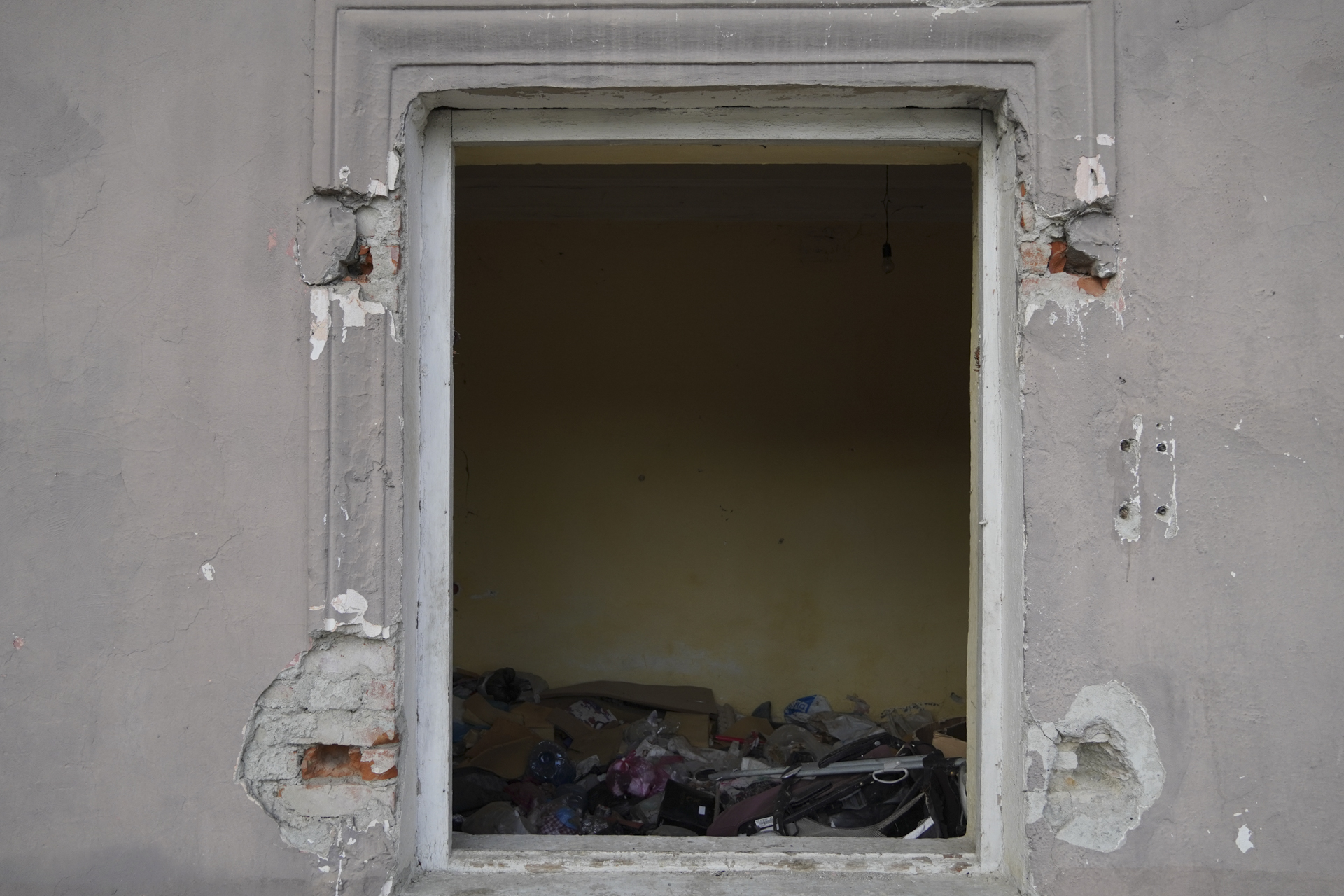
Murat’s apartment is in a terrible state / Photo: Atdhe Mulla / K2.0
The roof of the second floor is completely damaged; the sky is visible through the broken tiles. According to Murat, some time after the earthquake, a fire engulfed the building, causing further destruction.
“They want to demolish it and turn it into a palace. It’s in the center here — it could go for 2,000 euros per square meter,” he says. Murat suspects that there may be another motive behind the delay in renovating the building where he once lived, owing to the fact that the current government, led by Prime Minister Rama, has given wide approval for high-rise construction throughout Albania, especially in the capital, often taking drastic measures to facilitate private development projects.
The most well-known example is the case of the National Theater, a project that became a major political, legal and cultural controversy in Albania from 2018 to 2020. The dispute centered on the Albanian government’s decision to demolish the historic National Theater building in the heart of Tirana and transfer the land to a public-private partnership, enabling the construction of high-rise towers around the prospective theater.
Murat cannot help but think that something similar could happen to the building where his apartment is located — the home he has lived in ever since his family, like thousands of other Albanians, lost their wealth, including their homes, during the collapse of the pyramid scheme in the late 1990s.
What were pyramid schemes?
In the mid-1990s, Albania was engulfed by pyramid investment schemes that attracted hundreds of thousands of citizens by promising extremely high profits. The schemes grew rapidly after 1995 due to a weak financial system, a lack of rule of law and a limited understanding of the market economy among the public following the fall of communism.
Many of the companies behind these schemes operated Ponzi models, using new deposits to pay earlier investors. By early 1997, about one-third of the country’s Gross Domestic Product (GDP) had been invested in these fraudulent schemes, creating a massive financial bubble.
When the schemes collapsed in early 1997, people across Albania lost their life savings, triggering nationwide unrest and the breakdown of state institutions. Military depots were looted, criminal groups gained influence and the country descended into chaos.
“We had nowhere to go, so we went inside,” says Murati, looking at the apartment where he lived until the earthquake struck. “There was a Textile Factory. Then came the period when the building was privatized, and we bought the section where we had been living since we moved in. I have the deed — it’s my property,” he says.
The Kombinati neighbourhood in Tirana was established in the early 1950s with assistance from the Soviet Union, and was designed as both an industrial and residential zone. When completed, it became the largest textile factory in Albania and was known as the Stalin Textile Factory. Because the project held significant ideological and economic importance, the surrounding area was named after it — initially the Stalin Factory, and later simply the Factory — a name from which the entire neighborhood eventually took its identity.
To support the factory’s large workforce, the socialist government built extensive planned housing units for workers throughout the 1950s and 1960s. These included dormitories, schools, kindergartens, cultural centers and shops. The goal was to create a socialist neighborhood where workers could live, work and access all essential services. As a result, Kombinat functioned almost like a small city within Tirana.
Following the fall of communism in 1991, various departments of the factory complex were shut down, sold or transformed into joint-stock companies in which the state held majority shares. By 2004, most of Kombinat’s former industrial structures had been either demolished or repurposed for commercial or residential use, marking the end of the factory’s era as a state-owned industrial enterprise.
With the process of deindustrialization, the neighborhood’s socio-economic profile has waned, reflecting a broader trend in Tirana in which suburban areas face greater economic hardship.
Kombinati is considered one of the lowest-income neighborhoods in Tirana. Data from the national statistics agency (INSTAT) indicate that in 2021, about 22% of families in Albania were at risk of poverty, which helps contextualize the state of suburban neighborhoods in the capital. Research on housing and the socio-economic structure of Tirana highlights that suburbs often house low-income families with limited access to public services and social housing programs.
Today, entering the Kombinati neighborhood from the center of Tirana feels like stepping away from an open blue sky into a dark tunnel. The houses are old, low-rise buildings. The few streetlights cast a faint, lukewarm glow that illuminates the mud filling in the street’s potholes.

In Kombinat, some of the buildings rebuilt by the government have been released back to residents, others are still in the process of reconstruction / Photo: Atdhe Mulla / K2.0
A lane next to the municipal unit leads to three new buildings. In some of the apartments, clothes can be seen drying on balconies, and lights are on, indicating that residents have returned. One resident of the area explained that some of the new constructions are earthquake-related projects, as this was a heavily damaged zone, and the government has already allocated a number of apartments to affected families. They say the first apartments were distributed in February of this year, with others to be handed out later.
Besides the new buildings, the surrounding area remains completely destroyed, with piles of concrete from demolished homes scattered across a wide space where excavators continue to operate.
From Small Peza to Kombinat
In Peza e Vogël, across the street from the Peza Lapidar monument, Xhevrije Çeka, now 59, lived with her son, her daughter-in-law, and two children. On the night the earthquake struck, Xhevrije’s house collapsed and became uninhabitable.
At first, the family moved to a rented apartment in the Kombinati neighborhood, where they paid 15,000 lek per month (about 150 euros). After a few years, they were forced to leave that apartment when the owner decided to build a new house on the property. The apartment they moved into afterwards — where they still live — has a higher rent of 20,000 lek (about 200 euros). Xhevrije says she pays the rent herself and does not receive any other state assistance.
Xhevrije adds that the state minimally helped in repairing her house, which is why she has not been able to return home.
“They gave me 700 thousand lek (about 700 euros), and the house is worth far more than that. We were renting and barely making ends meet, so we accepted it. They told me that this is how much it would cost to fix the house,” she says. “In my neighborhood, everyone else was helped but me.”
She lives with her son, who suffers from a stomach disease and struggles to work. Her husband died shortly before the earthquake at the age of 55, while her daughter now lives in Italy.
“The water and electricity cost a lot. We can’t stay in the old house because we’re afraid that if another earthquake hits, the house might collapse. Last summer I went [to the Municipality], and told them my house has not yet been restored,” she said. “They told me I have received all that I am entitled to and won’t receive anything else.”
A few meters from the square where the Stalin statue once stood is the fruit and vegetable market. Xhevrije lives off the income she earns from selling goods on the street — products she buys from villagers in Peza.
“I live with great sacrifices. I go out on the street and sell village products; I buy a small portion of goods from the villagers, for five lekë, do you understand me?” she says. “I don’t know… I told them I didn’t agree with the amount offered, but they didn’t listen to me. I’m still strong and able to work, but I don’t know what will happen in the future.”
In several areas, such as Thumanë, a village located between Tirana and Shijak near Durrës, reconstruction has been completed, and residents have moved back into their new apartments, despite delays. In other parts of the country affected by the earthquake, however, such as Kombinat and Pezë, many residents continue to live in rented accommodation, as reconstruction has been marred by numerous irregularities, mismanagement and suspicions of corruption. The pandemic also contributed to the delays.
A year earlier, the media in Albania reported that hundreds of families in the Tirana area, including Kombinat, were still homeless. The Office of Ombudsman had likewise expressed concern about the reconstruction process.
Albanian media have also reported that many residents outside Tirana, including those in Durrës, are still unable to return to their homes and are facing various financial difficulties. In Durrës, as recently as this year, several buildings that were partially damaged by the earthquake are still awaiting demolition to make way for new constructions, but this process has not yet begun.
In an email response to K2.0, the Municipality of Tirana stated that Kombinat and Peza are among the areas designated “for development,” along with five others — the 5 Maji neighborhood, Baldushku, Ndroqi, Vaqarr and Zall-Herr. Concerning Kombinat specifically, the Municipality stated that the area “is still in the reconstruction process.”

Six years after the earthquake, many affected residents are still waiting for housing solutions / Photo: Atdhe Mulla / K2.0
Following the earthquake, the Albanian government struggled to effectively manage the reconstruction process overall.
One of the main concerns surrounding post-earthquake housing reconstruction has been the misuse of reconstruction funds. In some municipalities, officials were accused of allocating funds to buildings that had not been damaged — or even to structures that were not residential, such as stables or agricultural facilities. In at least one case, several local officials were arrested on suspicion of inflating damage assessments and misusing public funds, causing significant financial losses to the state.
Another major issue concerns the Rama government’s decision to continue using accelerated procurement procedures for reconstruction works long after the immediate post-earthquake emergency had passed. These expedited procedures reduce transparency and competition, allowing contracts to be awarded with far less oversight. Critics, including international organizations such as Transparency International, warned that the prolonged use of such procedures created fertile ground for corruption and cronyism.
In addition, another major issue concerns the reconstruction process itself. Some rebuilt buildings or apartments were completed but never officially approved by municipal experts. Residents were informed that their apartments had been reconstructed, yet the buildings had not been certified as safe. In some cases, families were forced to move into unapproved structures because government rental subsidies were cut off, and they had no other options.
The situation for residents who have remained homeless years after the earthquake has been further complicated by Albania’s long-standing issue of informal housing. Many affected families do not possess full ownership certificates. Because of missing or incomplete documentation, they struggled to access reconstruction funds or receive compensation, leaving them in prolonged uncertainty.
Six years after the earthquake, uncertainty still persists. As Murat and Xhevrije continue to visit their destroyed and abandoned homes, they hold onto the fading hope that one day they will return and live in them again.
Feature image: Atdhe Mulla / K2.0